Showing posts with label dinosaur sightings. Show all posts

Tuesday, July 16, 2013

Shocking Find! - Dinosaurs Found to be Living Recently - Dr. Mark Harwood


Christian Media ProductionsChristian Media Productions
https://www.facebook.com/christianmediaproductions
http://www.youtube.com/user/cmpaus

Dr Mark Harwood of Creation Ministries International unravels evidence showing that dinosaurs lived within the last few centuries! Who knew?


Dr Mark Harwood

Mark Harwood completed his tertiary education at the University of Sydney where he received B.Sc., B.E. (Hons) and Ph.D. degrees. His postgraduate studies were focused on radiotelescopes and computer techniques for antenna design and measurement.

Mark played a key role in the development of Australia’s national satellite system from its inception in 1980. He was responsible for the conceptual system design and payload system for four generations of Optus satellites. These satellites were designed to deliver direct-to-home television services and general communications services throughout Australia and New Zealand. Mark has now retired from Optus where he was General Manager, Strategy and Planning for the satellite business.
During his university years, Mark was something of a ‘closet Christian’ because he could not understand the basis of his faith. He assumed that God must have created through the processes of evolution (theistic evolution) but that idea provided no meaningful basis for Christ’s sacrificial death on the cross. When he was confronted on the historical truth of Genesis he realised that the early chapters of Genesis were actually true and fundamental to the Christian faith. His subsequent journey of investigation convinced him of the theological and scientific basis of the Genesis account of creation.

Dr Harwood is now employed by CMI as a speaker and has oversight of the Australian support groups and speaker development program. Today, he speaks passionately about the relevance and the scientific integrity of the Genesis creation account, both in Australia and internationally.

Articles published with Creation Ministries International:


Friday, April 12, 2013

The Record of the Rocks and the Geologic Column | Dr. Don Patton


http://bible.ca/tracks | Evolutionists tell us that the gradual development of life has been recorded in the record of the rocks, illustrated in textbooks by the geologic column. It is seldom revealed that this column is actually a mental abstraction constructed with evolutionary assumptions. The complete column is found only in the textbooks, nowhere on the face of the earth. The column does illustrate evolutionary predictions and thus provides a means of testing the evolutionary model. Leading evolutionists acknowledge that finding a contradictory sequence would falsify evolution.

Dr. Patton demonstrates that this has been done again and again: skeletons of modern men, fossilized human footprints and human artifacts in the same layer with dinosaurs; Native American petroglyphs of dinosaurs; Peruvian and Mexican dinosaur artifacts. This is crucial, exciting evidence that you should see for yourself.

The Record Of The Rocks
Add to Cart
(Failure Of Geological Column & Alternate Explanation)
Click to View
DVD - $12 US Each (Plus postage)

Friday, February 22, 2013

Dinosaurs and Man Coexisted - Evidence from Acambaro, Mexico | Dr. Don Patton


The content below is from Dr. Patton's website at http://www.bible.ca/tracks/tracks-acambaro.htm


The Dinosaur Figurines Of Acambaro, Mexico

Amazing evidence that dinosaurs and humans coexisted.

Click to View
Click to View Mystery Of Acambaro With Pictures 
Click to ViewInitial Report Dr. Dennis Swift
Click to View
Preliminary Report From Second ExpeditionDr. Dennis Swift
Click to View
Click to ViewPhotogallery of 75 dinosaur figurines
Click to View
Click to View12 witnesses to the authenticity of the Julsrud Artifacts.
Click to ViewNew Julsrud Museum Acambaro Mexico
Click to ViewWhat evolutionists have said if man and dinosaurs co-existed.
Click to ViewVideo!(Real Player needed)Photo Documentation
Click to View
1:03 hours
Dino Art in MexicoBelow are high resolution photos that you can view before or after the video. Enjoy!

Click to View

Here is the location of
Acambaro, Mexico
Click to View
Click to View
(Click on a photo for high resolution)
El Toro

El Chivo
Click to View
(Click on a photo for high resolution)
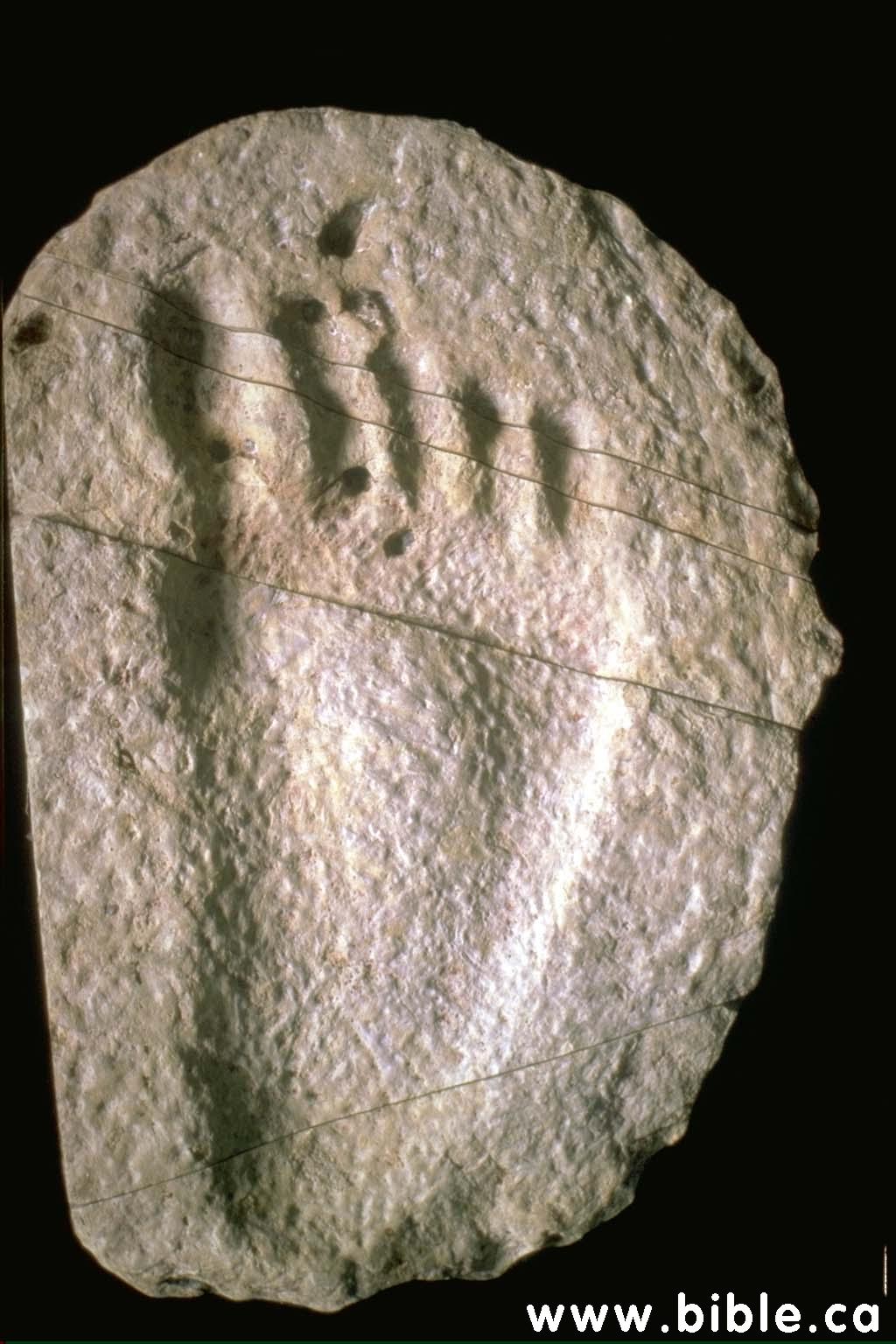
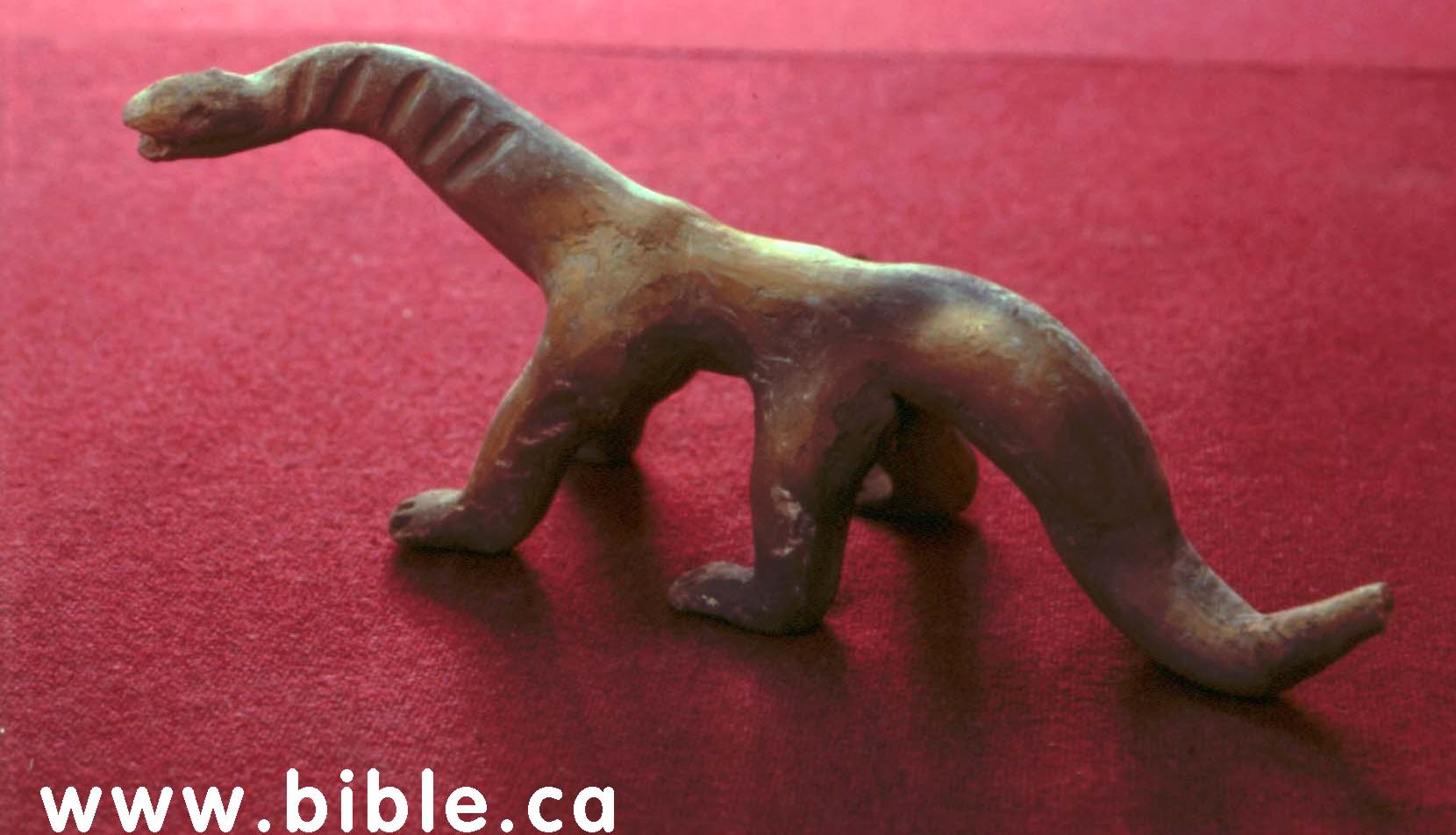
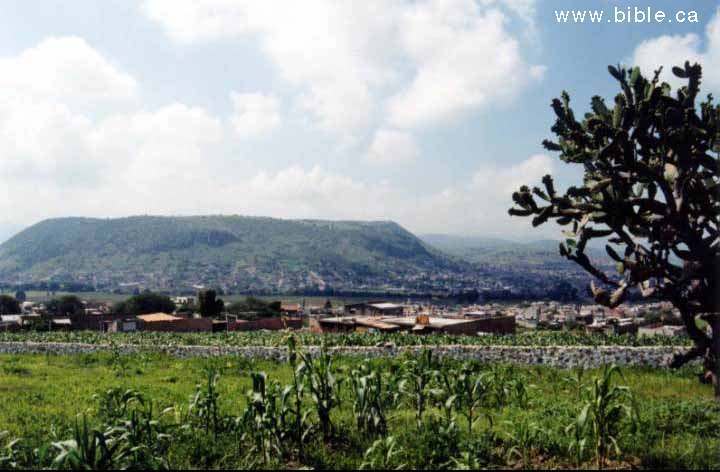
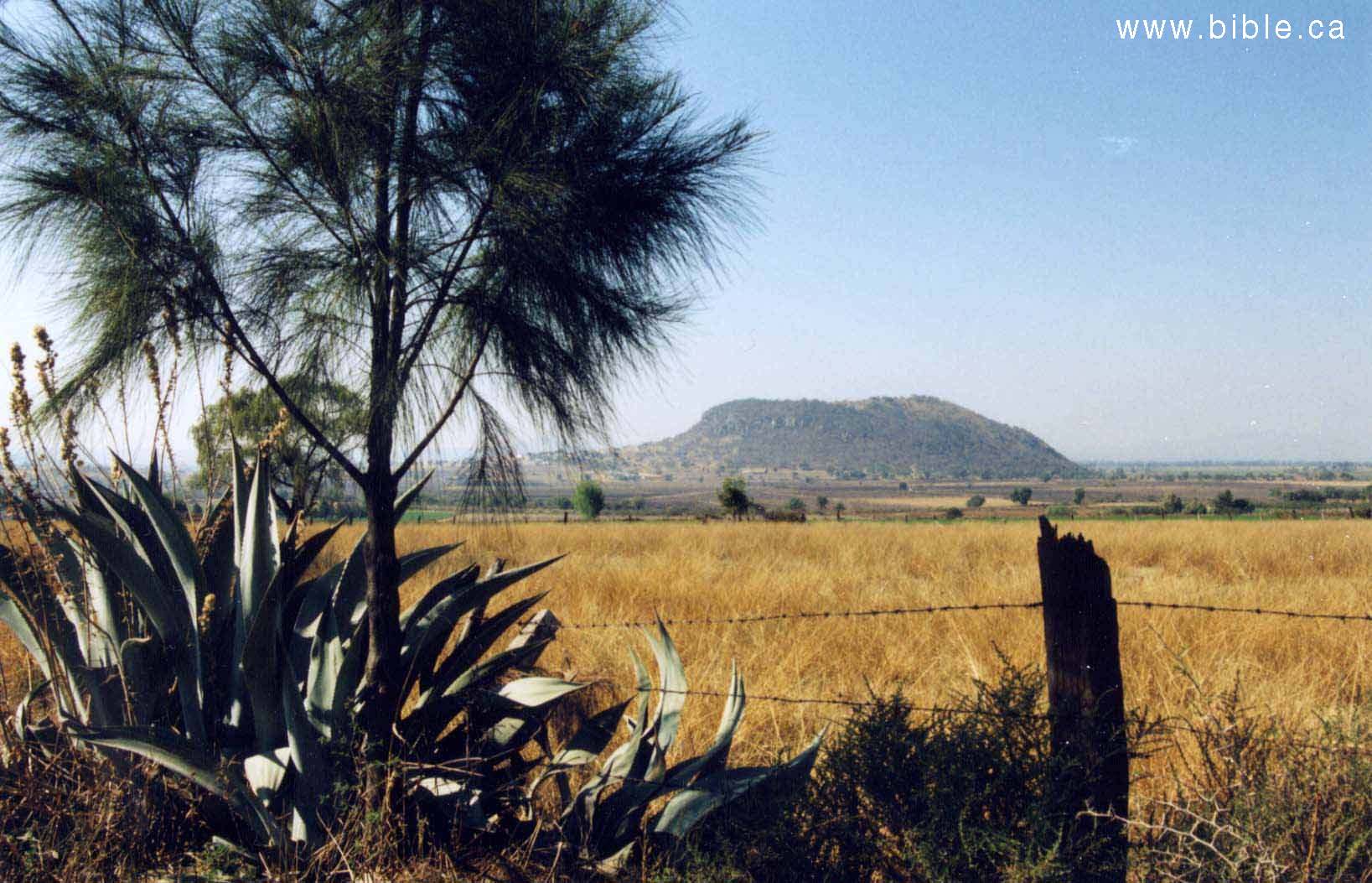
In 1945 Waldemar Julsrud, a German immigrant and knowledgeable archeologist, discovered clay figurines buried at the foot of El Toro Mountain on the outskirts of Acambaro, Guanajuato, Mexico. Eventually over 33,000 ceramic figurines were found near El Toro as well as Chivo Mountain on the other side of town. Similar artifacts found in the area are identified with the Pre-classical Chupicuaro Culture (800 BC to 200 AD).

The authenticity of Julsrud find was challenged because the huge collection included dinosaurs. Many archeologists believe dinosaurs have been extinct for the past 65 million years and man knowledge of them has been limited to the past 200 years. If this is true, man could not possibly have seen and modeled them 2,500 years ago.

During the years 1945 to 1946,Carlos Perea was Director of Archeology, Acambaro zone, for the National Museum of Anthropology in Mexico City. In a recorded interview he described Julsrud excavations as unauthorized, as were many similar discoveries made by local farmers, but he had no doubt that the finds were authentic. He acknowledged that he examined the figurines, including dinosaurs, from many different sites. He was present when official excavations were conducted by the National Museum and the American Museum of Natural History. They found many figurines, including dinosaurs, which he described in detail.
In 1954 the Mexican government sent four well known archeologists to investigate. A different but nearby site was selected and a meticulous excavation was begun. Six feet down they found numerous examples of similar figurines and concluded that Julsrud find was authentic. However, three weeks later their report declared the collection to be a fraud because of the fantastic representation of man and dinosaur together.
In 1955 Charles Hapgood, respected1 Professor of Anthropology at the University of New Hampshire, conducted an elaborate investigation including extensive radiometric dating. He was accompanied by Earl Stanley Gardner, former District Attorney of the city of Los Angeles, California and the creator of Perry Mason. They falsified the claim that Julsrud manufactured the figurines, by excavating under the house of the Chief of Police, which was built 25 years before the Julsrud arrived in Mexico. Forty three more examples of the same type were found. Three radiocarbon tests were performed by Isotopes Incorporated of New Jersey resulting in dates of 1640 BC, 4530 BC and 1110 BC. Eighteen samples were subjected to thermoluminescent testing by the University of Pennsylvania, all of which gave dates of approximately 2500 BC. These results were subsequently withdrawn when it was learned that some of the samples were from dinosaurs.

In 1990 an investigation was conducted by Neal Steedy, an independent archeologist who's livelihood depends on contract work from the Mexican government. He arbitrarily selected an excavation site considerably removed from the Julsrud site. Chards were found but no figurines. He commissioned radiocarbon tests for samples from the Julsrud Collection which produced a range of dates from 4000 to 1500 years ago. Then he decided to ignore the results because he claimed the figurines were too soft to last more than 20 years in the ground. He also ignored the fact that many of the acknowledged Chupicuaro pieces are of the same consistency and they survived just fine. Of course, some pieces in the Julsrud collection are beautifully fired. Steedy's effort does more to support Julsrud collection than to refute it. He effectively demonstrates the determination of the establishment to defend evolutionary dogma in the face of the devastating implications of this truly significant find.

(footnote 1: In the forward to the book, Earth's Shifting Crust, Albert Einstein said Hapgood's concept could be of "great importance to everything that is related to the earth's surface.")

 Click to View
The Dinosaurs Of AcambaroInitial report

by Dr Dennis Swift Ph.D.

Waldemar Juisrud, a German hardware merchant in Acambaro, Mexico, was riding his horse on the lower slope of El Toro (The Bull) Mountain on a sunny morning in July, 1944. Suddenly he spotted some partially exposed hewn stones and a ceramic object half buried in the dirt.

Waldemar dismounted and dug out of the ground the hewn stones as well as a few ceramic pieces. Juisrud, who was archaeologically astute, immediately realized that these ceramic pieces were unlike anything that he had seen. He was familiar with Tarascan, Aztec, Toltec, Mayan, Chupicauro, Inca and pre-Incan Indian civilizations. The objects he held in his hand were distinctively different than any other known Indian culture.
Waldemar in 1923 was co-discoverer with Padre Fray Jose Marie Martinez of the Chupicauro culture at a site just eight miles away. When a few ceramic fragments were found at Chupicauro, Julsrud hired diggers to excavate. This discovery brought world wide attention from archaeologists who at first mistakenly defined them as Tarascan, but later they were correctly identified as a whole New Indian culture -the Chupicauro. The Chupicauro civilization flourished from about 500 BC to 500 AD, roughly a thousand years before the Tarascan.

Julsrud at age sixty-nine was on the brink of making a discovery that may prove to be the greatest archaeological discovery ever made. Waldemar hired a Mexican farmer, Odilon Tinajero, to dig in the area where the ceramic figurines were found and bring him any other similar objects. Soon Tinajero had a wheelbarrow full of ceramic pottery that had been excavated on El Toro Mountain.
Charles Hapgood notes that "Julsrud was a shrewd businessman and he now made a deal with Tinajero that is very important for our story. He told Tinajero that he would pay him one peso (worth about 12 cents) for each complete piece he brought in."1

Tinajero was very careful with the excavation process so as not to break the pieces, and the broken ones were cemented together before being brought to Julsrud.

Among the thousands of artifacts excavated were items that turned Julsrud's mansion into "the museum that scared scientists." Sculpted in various colors of clay were figurines of dinosaurs, various races of people Eskimos, Asians, Africans, bearded Caucasians, Mongols, Polynesians, and objects that had cultural connections with the Egyptians, Sumerians as well as others.

The objects were made of clay and stone varying in size from a few inches long to statues three feet high and dinosaur objects four to five feet long. In the collection, that now numbered over 20,000 not one object could be found to be a duplicate another. Each of the clay pieces had been individually made, without molds, skillfully sculptured, and carefully decorated. In its collection of unequaled size, dinosaur figures numbering several hundred were scientifically identified as representing many species of dinosaurs. Dinosaurs including duck billed Trachodon, Gorgosaurus, horned Monoclonius, Ornitholestes, Titanosaurus, Triceratops, Stegosaurus Paleococincus, Diplodicus, Podokosaurus, Struthiomimos, Plesiosaur, Leviathan, Maiasaura, Rhamphorynchus, Iguanodon, Brachiosaurus, Pteranodon, Dimetrodon, Ichtyornis, Tyrannosaurus Rex, Rhynococephalia and other unknown or yet unidentified Dinosaur species.

These fantastic dinosaur figurines threaten the orthodox concepts and time scales in many fields of studies. Dr. Ivan T. Sanderson was amazed in 1955 to find that there was an accurate representation of its American dinosaur Brachiosaurus almost totally unknown at that time to the general public. Sanderson wrote about this particular Dinosaur in the Julsrud collection. "This figurine is a very fine, jet-black, polished-looking ware. It is about a foot tall. The point is it is an absolutely perfect representation of Brachiosaurus, known only from East Africa and North America. There are a number of outlines of the skeletons in the standard literature but only one fleshed out reconstruction that I have ever seen. This is exactly like it."

In the 1940s and 1950s as the Julsrud collection was amassing, the state of Guanajuato, Mexico was little explored paleontogically and archaeologically and remains so today. But here in the agriculturally rich Valley of Acambaro within the last four thousand years lived a civilization or civilizations that had an intimate "first hand knowledge" of dinosaurs.

In 1999 Dr. Dennis Swift and Dr. Don R. Patton journeyed to Acambaro about 180 miles North of Mexico City to explore its mystery personally. Soon after our arrival in Acambaro it was revealed that the Julsrud collection was locked up in storage and not available to the public. After a couple of days of negotiating with the Mayor, Secretary of Tourism and Director of the Acambaro museum permission was given to view a portion of the collection. The storage area was ceremonially unlocked by the mayor; dim light filtered through the shadows as we peered into the dusty rooms and boxes were piled to the ceilings with artifacts wrapped in newspaper and haphazardly placed in crumbling cardboard containers.

The conference room adjoining the Mayor's office was eventually offered to view the artifacts as two Mexican policemen stood guard watching us armed with AK 47 rifles and pistols. City employees scurried back and forth bringing boxes upstairs as Dr. Swift unwrapped ceramic figurines while Dr. Patton professionally photographed them.

The collection at its largest numbered 33,500 figurines including musical instruments, masks, idols, tools, utensils, statues, human faces of many different nationalities and dinosaurs. The figurines eventually took over the twelve room Julsrud mansion crammed into every corner and lining the floor until Julsrud had to sleep in the bathtub for that was the only place left.

Working at a fast pace, in a six hour period, a little more than eight hundred of the ceramic figurines were unwrapped. Fourteen boxes had been opened and emptied of their contents onto the conference table. Among the items were about seventy-five exquisite dinosaur pieces.

There was an absolutely astonishing breathless moment as one object was unwrapped and there before us a virtually perfect representation of an Iguanodon. This was one of the first dinosaur skeletons discovered. The early concept of it's appearance was almost comical in the mid 1800's. By the turn of the century it had improved considerably but fell far short of what we now know. The figurine exhibits knowledge we have gained only in the last few years. No hoaxer could have made this model in the 1940's.

The authors became overnight celebrities in Acambaro being interviewed on radio and TV stations in Mexico. Three major newspapers in the state of Guanajauto made us front page headline news in Mexico. I handed out Dinosaur T-shirts to politicians and suggested we could make Acambaro a tourist attraction with Dinosaurs of Acambaro T-shirts, postcards, and a dinosaur park. People would come from around the world to see the Acambaro collection with dinosaurs.

Dr, Swift accidentally touched off a national scandal as he inquired, "How many boxes do you have in storage?" I was told there are sixty-four and then I muttered to myself, "There were once 33,500 figurines and here there can only be 5,000 to 6,000 at most left." A newspaper reporter overheard the comment and the next week the authors again became front-page news as an investigation was launched into the whereabouts of the artifacts.

Julsrud also stirred up controversy over the collection but its gathering storm on the horizon of history took several years before releasing its full fury on the scientific community. Unconfined by academic restraints or burdened by preconceived ideas, he began to speculate as thousands of figurines were unearthed all baked by the open fire method. The most startling sensational feature of the collection was dinosaurs and humans in close relationship to one another. Waldemar pondered the very real possibility that these artifacts came from a culture much older than the Olmecs, Mayans or Chupicauro.

The collection contained evidence of a culture of vast antiquity. The objects pointed to a woodland setting and that the Acambaro area was once a heavily forested area instead of a dry valley as it is today. Geologists have found that the valley was once filled by a large lake, until about five or six thousand years ago. The site of the caches of ceramic pottery objects was once the beach of the lake. Originally the objects were buried in sand. The fauna, plants, trees, flowers represented the art of this unknown civilization was that of the woodland, lakes, and forest environment.

Julsrud tried to gain the attention of the scientific community but was met with indifference and academic silence. Since archaeologists, paleontologists, historians, and anthropologists chose to ignore him, Julsrud proceeded to publish his own book in Spanish Enigmas Del Pasado. Waldemar in print theorized that the colossal collection of ceramic and stone artifacts had been buried by a people who experienced catastrophes. He conjectured that there had been period of catastrophes that had changed the face of the earth and that there must have been ancient civilizations wiped out by the catastrophes. His most radical suggestion that clashed violently with scientists was that man had existed contemporaneously with the dinosaurs.

Although there was sound evidence that Julsrud was on to something of major scientific importance, he was ridiculed by the authorities when his book was published.

Was there a precursor civilization at Acambaro during the Ice Age as geologists reckon time? In the collection are unmistakable representations of the one humped American camel of the Ice Age, Ice Age horses, as well as of animals resembling rhinoceroses of extinct species. There are many figurines of giant monkeys such as actually existed in South America in the Pleistocene.

During excavations among the figurines were found some teeth. These teeth were taken to Dr. George Gaylord Simpson in 1955, at that time America's leading paleontologist who worked at the American Museum of Natural History. He identified them as the teeth of Equus Conversidans Owen, an extinct horse of the Ice Age. In the Julsrud collection are two figurines of Equus Conversidans Owen. The image of the Ice Age horse is also engraved on ceramic pots in the collection.

In 1947, upon the publication of Julsrud's book, a few newspapers and magazines in Mexico briefly reported on the discovery. But Julsrud could not get any scientists or authorities in Mexico to come and investigate the excavation of the figurines for themselves.

Finally in 1950 an American newspaperman, Lowel Harmer, ventured to Acambaro to inspect the collection. Harmer went to the site of El Toro mountain and photographed Julsrud and the digging while some dinosaur figurines were being extracted from under the Maquey roots in a new excavation. He reported, "'Anyone would feel that these great saurians could only be created by long gone artists who knew them well."2

The establishment scientists continued to act as if nothing of significance had happened in Acambaro that would threaten the evolutionary paradigm. Despite their efforts to downplay or explain away Julsrud's discoveries as that of an eccentric kook, the information was slowly leaking out to a wide audience that would take the Julsrud collection seriously and consider it a legitimate find.

William W. Russell, a Los Angeles newspaperman was soon on the scene. Russell himself photographed the excavations. Freshly dug pits produced objects, with roots entwining them.3 The objects must have been in the ground for many years for tree roots to grow around them at a depth of five or six feet beneath the earth. Russell reported that he judged from the evidence the objects to be very old.

The discoveries were now too far disseminated into the literature of the general public for scientists to intellectually suppress them with the cloak of academic silence. The professional archaeologists would have to deal with the irritating problem in Acambaro.

In 1952 Charles C. Dipeso of the Amerind Foundation felt the popular accounts circulating in the newspapers and magazines (such as Fate 3) prevailed upon him to begin an examination of the strange collection. Samples were sent and laboratory tests of them proved nothing." Dipeso thought the tests would dismiss the collection as a hoax because they would demonstrate them to be of modern manufacture.

The figurines could not be falsified merely because of the life forms representing Mesozoic reptiles. Dipeso in June of 1952 arrived in Acambaro to examine the collection owned by Juisrud. Taking no more than four hours he claimed to have viewed 32,000 items in the mansion. In fact, he asserted his examination was very precise and thorough to the extent that he detected the figurines depressions forming eyes, mouth, scales to be sharp and new. No dirt was packed in any of the crevices. 4

Dipeso must have been the bionic archaeologist, handling objects at speeds that exceed those of superman's. To have achieved this Herculean feat he would have to inspect 133 artifacts per minute steadily. In reality, it would take several days to unpack the massive jumble of intact, broken, and repaired pieces from the boxes. Once the boxed pieces were disentangled and set up with those already on display in the mansion, it would take many more days to even give a cursory examination.

Charles Dipeso said that further investigation revealed that a family living in the Acambaro area made the figurines during "the winter months while their fields lie idle." Dipeso believed his family of hoaxers got their ideas from the local cinema, comic books, newspapers or books from the local library.

It appears that even Dipeso did not truly believe the Julsrud collection was a fake. Before he returned to America to write the articles denouncing the collection, Julsrud stated,. "Mr. Dipeso declared to me that he had been completely convinced of the genuineness of my discovery. He wanted to buy for his museum a certain amount of pieces of Tarascan origin." Julsrud would not sell any of the artifacts but sent Dipeso to another man who dealt in antiquities. That dealer told Dipeso that Julsrud's ceramics came from a man and his three children who lived thirty minutes outside of town near the irrigation plant of Solis. Juisrud said, "Why then didn't Dipeso go there and find out the truth? The obligation of a serious scientist is to investigate himself and not give credence to the first man who tells him something."

In the first place, it was against the archaeological code of ethics and illegal for Dipeso to be acquiring Indian artifacts to take out of the country. Secondly, the black market antiquity dealer who sold Dipeso the artifacts had obvious motivation to make sure that Dipeso didn't buy from Julsrud, so we have no difficulty understanding why the dealer made up the story of the hoaxer family.

Francisco Aguitar Sanchaz, Superintendent of the National Irrigation Plant of Solis said, "That on the basis of four years intimate knowledge of the inhabitants of the entire area and of archaeological activity there, he could positively deny that there was any such ceramic production in the vicinity." The Municipal President of Acambaro, Juan Terrazaz Carranza, issued on July 23, 1952, an official statement No.1109 refuting Dipeso's allegation.

'This Presidency under my direction ordered that an investigation be carried out in this matter, and has arrived at the conclusion that in this municipal area there does not exist any persons who makes these kinds of objects."

There are many other problems associated with Dipeso's spurious allegations. He fails to mention that the ceramic artifacts of varying clay composition and styles had been individually and not mold-made. There were not only ceramic pieces but also stone pieces.

The ceramic collection has unsurpassed variety and beauty that has won the admiration of professional artists. No peasant family could possibly make thousands and thousands of non-duplicated sculptures with such skill and artistic finesse.

The famous Earle Stanley Gardner, whose detective mysteries became the basis for the famous Perry Mason television programs, was a forensic pathologist and attorney who served as district attorney for the city of Los Angeles for over 20. Mr. Gardner examined the collection and voiced the expert opinion of an experienced prosecuting attorney when he said that if a group of fakers had made all the pieces, their style would be recognizable on the whole collection.

"Every criminal, every criminal gang has its own method of operations. Police can often identify a criminal or gang from the method of a crime. It is obvious that no one individual or group could have made the pieces."
Charles Dipeso insisted in his insinuations that the collection was an elaborate hoax; the diggers making pits, burying the objects, and later digging them up. Dipeso finished his 1953 report with resounding confidence, "Our investigation proved conclusively that the figurines are not prehistoric and were not made by a superior prehistoric race that associated with dinosaurs."5

Much of Dipeso's report was absolutely unfounded or mere conjecture. What would be the motive for faking the objects? Economically, at 12 cents a figure, for a hoaxer to manufacture the objects, to say nothing of the additional costs to bury them and then dig them up again, Tinajero, a poor Mexican farmer, could never have afforded to make 33,500 figures under these circumstances.

The collection is not only skillfully made but contains dinosaur species that only a highly educated person who had burrowed deep into the recesses of paleontological literature could have known of the rare life forms. Odilon Tinajero had neither the artistic competence or educational background to perpetuate such a hoax. Tinajero left school in the fourth grade and could barely read or write.

Acambaro is a dry, arid, and relatively treeless area, yet all the ceramic objects had been baked in open fires. This would require many truckloads of firewood which is very expensive in Acambaro. It would have been consumed consistently. The smoke rising from the fire could not have possibly gone undetected by the entire community.

Professor Ramon Rivera of Acambaro High School's history faculty launched a month long investigation, interviewing people of all ages and occupations. Professor Rivera had a vast knowledge of the history of the area and close contacts with the inhabitants of Acambaro.

Rivera filed this report,

"The truth is that there is not the most remote idea suspicion of there having lived in Acambaro, or near or far from here, anyone who made in quantity or little by little such pieces. This fact has been investigated by all possible means, covering the time from more than a century ago up to now. There are old people living here who can still give details otherwise unrecorded from the date of the independence of this country."

Another consideration that is often ignored in the debate over the authenticity of the artifacts is that many of them are made of hard stones and not of ceramic. These stone objects show all the effects of erosion and the stone objects are of the same style as the ceramics and the erosion factor is almost impossible to fake.

In 1954, the storm of controversy surrounding the Julsrud collection reached such a crescendo of interest that official archaeologists of the Mexican Government decided to investigate. Dr Eduardo Noquera, director of Pre-Hispanic Monuments of the Instituto Nacional de Antropologiae Historia, was the lead investigator. Dr. Noguera was accompanied by Rafael Orellana, Ponciano Salazar, and Antonio Pompa y Pompa of the Instituto Nacional de Antropologiciae Historia, upon arrival they inspected the collection and proceeded to El Toro Hill to select undisturbed sites for excavation.

Dr. Noguera supervised the dig at a site that he and the other prominent Mexican archaeologists selected. After several hours of digging many figures were discovered. The archeologists declared that the pieces gave every sign of antiquity and of having been buried a long time ago. The figurines were dug up in the presence of a number of witnesses which included people from the local schools and members of the Chamber of Commerce. Immediately the archeologists congratulated Juisrud on his remarkable discoveries. Two of the archeologists promised to write about the discovery in a scientific journal.

Noquera realized that the dinosaur figurines posed a problem that could ruin his professional career. The archeologists simply faced a dilemma to either tell the truth, that regardless of what anybody may think they had chosen a site and dug up dinosaur figures or to hide the truth in some alternative explanation.
Noquera went back to Mexico City and three weeks later submitted a report with his subordinates that the collection must be a hoax because of the life forms involved - dinosaurs. Dr. Noquera wrote,

"Actually in spite of the apparent scientific legality with which these objects were found, it is a case of reproduction and to say falsification, made in a relatively recent epochs. In my opinion it is composed of three types of objects one of them figurines which pretend to be time reproductions of animals extinct for millions of years; possibly the maker of these objects was inspired by some books on paleontology which were in vogue at the end of the past century or the beginning of the present one."

Julsrud was gravely disappointed that in a span of a few weeks, the archaeologists first vindicated the collection and then cleverly maneuvered to deny their own discoveries. Juisrud, undaunted by all the academic goofy dust sprinkled over the collection by rigid orthodox scientist's to make it go away, pressed on in his efforts to convince the skeptics.

Eventually, an eminent scholar arrived on the scene in Acambaro who would expose the contentions of Julsrud's opponents with a series of arguments and facts that would prove to be indisputable. In the summer of 1955 Charles Hapgood, the Professor of History and Anthropology at Keene State College of the University of New Hampshire, spent several months in Acambaro and conducted a very detailed investigation of the collection. Charles Hapgood had already distinguished himself as the author of a number of books including "Earth's Shifting Crust" (1958), "Maps of the Ancient Sea Kings" (1966), and "The Path of the Pole" (1970).

Hapgood excavated a number of sites that were on previously undisturbed ground and found many pieces of ceramic figurines of the "Julsrud" type. To eliminate any possibility of fraud that Tinajero or anyone else had manufactured the ceramics, Hapgood decided to excavate beneath a house that had been built in 1930, long before any artifacts were found on El Toro Hill. They found a house directly over the site owned by the chief of police, asked permission to dig beneath the floor of his house. Permission was granted, and they dug a six-foot deep pit beneath the hard concrete floor of the living room, unearthing dozens of the controversial objects. Since the house had been built twenty five years before Julsrud arrived in Mexico, it exonerated Julsrud, eliminated the hoax theory and negated Dipeso's as well as Noquera's reports at all the important points.

In 1968 Charles Hapgood returned to Acambaro accompanied by Earle Stanley Gardner of Perry Mason fame. Mr. Gardner was not only trained in criminology but was also an investigator of archaeological problems. He was supremely impressed with the vastness and the variety of the collection. It was quite clear that Mr. Gardner considered the fake theory completely false, outrageous and deceptive!

The radiocarbon 14 method of dating was still in its infancy, but Hapgood acquired specimens for C14 testing.6 Gardner and Andrew Young (inventor of the Bell Helicopter) financed the testing.

Hapgood submitted the samples to the Laboratory of Isotopes Inc. in New Jersey. The results were as follows:
Sample No. 1(I-3842) 3590 + - 100 (C.1640 BC)
Sample No. 2(I-4015) 6480 + - 170 (C. 4530 BC)
Sample No. 3(I-4031)3060 + - 120 (C. 1110 BC)

The radiocarbon dates of up to 4,500 B.C for Carbon on the ceramics would make the collection the oldest in the Western Hemisphere.

In 1972, Arthur Young submitted two of the figurines to Dr. Froelich Rainey, the director of the Pennsylvania Museum for Thermoluminescent Dating. The Masca lab had obtained thermoluminescent dates of up to 2,700 B.C. In a letter dated September 13, 1972, addressed to Mr. Young, Dr Rainey said:

"...Now after we have had years of experimentation both here and at the lab at Oxford, we have no doubt about the dependability of the thermoluminescent method. We may have errors of up to 5-10% in absolute dating, but we are no longer concerned about unexpected bugs that might put the whole system in doubt. I should also point out, that we were so concerned about the extraordinarily ancient dates of these figures, that Mark Han in our lab made an average of 18 runs on each one of the four samples. Hence, there is a very substantial bit of research in these particular pieces... All in all the lab stands on these dates for the Julsrud material, whatever that means in terms of archeological dating in Mexico, or in terms of 'fakes verse's authentic' pieces."

But when the lab at the University of Pennsylvania found out that dinosaurs were part of the collection, they retracted their thermoluminescent. They asserted that the ceramics gave off regenerated light signals and could be no more than 30 years old.

A thermoluminescent technician admitted that no other ceramics existed, in his experience, that produced regenerated light signals, and no other thermoluminescent dating of ceramics had ever been done by utilization of a regenerated light signal. In short, the testing was a hocus pocus, laboratory trick to avoid the obvious conclusion that dinosaurs and man lived together.

John Tierney determined to expose the University of Pennsylvania's shenanigans by testing with standard procedures. Tierney had two fragments of Julsrud type ceramics excavated at El Toro Mountain in Acambaro and in 1956, in Julsrud's presence, Tierney submitted these pieces to Dr. Victor J. Bortolet, Director of Research of Daybreak Nucleari Archaeometrics Laboratory Services for dating. Dr. Bortulot determined the pieces' upper limit of age to 2,000 years old, thus, invalidating the Masca report which claimed the objects were made thirty to one hundred years ago.7

John Tierney took a half dozen samples of Julsrud ceramics of different clay composition to a team at Ohio State University. The team of experts consisted of Dr. J.O. Everhart (Chairman of the Department of Ceramic Engineering) Dr Earle R Caley, (among the world's most respected archaeological chemist) and Dr Ernest G Ehlers (mineralogist in the geology department at Ohio State University). They reported that they could not believe the artifacts were made in modern times nor could they believe they were made by some amateur who tried to perpetuate a fraud. Upon my notifying them that they had authenticated Julsrud artifacts they lapsed into a profound and apparent permanent silence.

In 1997 B.C Video released the program Jurassic Art with the Acambaro segment which was originally supposed to have been a part of NBC's television special, "The Mysterious Origins of Man." The program features Neil Steede, President of the Early Sites Research Society West and Mexican Epigraphic Society, attempting to debunk the collection, claiming it is of recent manufacture. Toward the end of the program, it is revealed that he sent two samples from the Juisrud type ceramics (one of a human figure and the other a dinosaur figure) to an independent C14 laboratory. Startling results came back. The human figure was dated at 4,000 years BP (Before Present) and the dinosaur figure at 1,500 years BP. Steede tap danced around implications, embarrassingly embracing the human figurine as credible, while waltzing past the dinosaur figurine, claiming the laboratory test must not have given a true reading. In reality, the dinosaur figurine created too much tension for orthodox science and Steede had to find an out. The solution was simple. He discarded the dinosaur date.

The Japanese company, Nissi, sponsored a television crew to go to Acambaro and produce a program for Japanese T.V regarding the Acambaro figurines. The program entitled "Did the Ancients See Dinosaurs" was aired on February 2, 1997 in Japan. There is a stunning moment in the program as the Japanese narrator is looking over an animal figurine, and he holds it up next to his Japanese book on dinosaurs. Amazingly, the Julsiud dinosaur figurine matches the color drawing of an Amargasaurus cazaai in the Japanese dinosaur book. The narrator quickly picks up another dinosaur figure and thumbs through the dinosaur book. This figure is very similar to the Sauraloplus osborni as drawn in the Japanese dinosaur book. The narrator ponders the perplexing problem that ancient people about 4,500 years ago must have seen dinosaurs because they could not have known what they looked like by merely seeing their skeletons in the ground. 

The narrator points out that when modern man found dinosaur skeletons such as Sir Richard Owen, that the life-sized models of Megalosaurus, Iquanodon and Hylaeosaurus were ridiculously inaccurate.

Footnotes1. Charles Hapgood, MYSTERY IN ACARNBARO, An Account of the Ceramic Collection of the Late Waldemar Juisrud in Acumbaro, GTU, Mexico. (Self Published, 1972).
2. Lowell Harmer. MEXICO FINDS GIVE HINT OF LOST WORLD, Los Angeles Times, (March 25, l951).
3. William N. Russell "Did Man Tame the Dinosaurs?" Fate, (March, 1952), pp 20-27; "Report on Acambaro," Fate. (June, 1953), pp.31-35.
4. Charles C. Dipeso, "The Clay Figurines of Acambaro," Guanajuato, Mexico, American Antiquity, April 1953, pp388-389.
5. Charles Dipeso, "The Clay Monsters of Acambaro," Archaeology (Summer, 1953), Pages 111-114.
6. Taylor and Berger, American Antiquity (Vol.33, No.3), 1968.
7. John H Tiemey, "Pseudoscientific Attacks On Acambaro Artifacts: The Ceramic Technology of Intellectual Suppression," World Explorer Magazine (Vol.1 #4), pp52-61.
Click to View

Preliminary Report From Second Expedition


by Dr. Dennis Swift


The claim has been made that only Waldamar Julsrud's excavations ever produced the distinctive ceramic objects that make up this collection. Why haven't other excavations found Julsrud type ceramics and dinosaur figurines? In August of 1999, Dr. Dennis Swift and Dr. Don Patton ventured back to Acambaro to seek answers to such questions. By chance while having dinner at a local Acambaro restaurant we met Ernesto Narrvete Marines. In the 1970's Ernesto was commander of the Federal Police for the Celaya zone of Guanajuanto, which includes the Acambaro area. Ernesto received a tip one night in 1978 that illegal excavations were taking place on Chivo (goat) Mountain and that the artifacts were being traded for pistols, rifles, machine guns as well as other weapons on the black market. Commander Ernesto Marines, who was trained at Scotland Yard, conducted a thorough investigation. The investigation revealed that artifacts dug up on Chivo Mountain were being taken to the border at Laredo, Texas and traded for arms, which was a Federal crime.

When Ernesto apprehended Jaime Aquirre and Raul Hernandez on Chivo Countain had in their possession 3,300 Julsrud type pottery figurines. The commander catalogued the collection as evidence and told us that he personally observed nine dinosaur figurines. Ernesto drew a sketch for us of the dinosaurs he had seen in the collection. These illegally excavated artifacts were handed over to Dr. Luis Moto, Mayor of Acambaro in 1978-1979, and kept in City Hall.

The artifacts were accepted as genuine by the Federal Court of Mexico when they were used as prima facie evidence in the trial of Jaime Aquirre and Raul Hernandez. Jaime and Raul were sentenced to the Federal prison in Mexico City where they are still serving time. If Jaime and Raul had been peddling phony pottery, fakes of modern manufacture, they would not have been sentenced to prison. Furthermore, the fact that Jaime and Raul were sentenced for trading genuine artifacts should silence the critics who say that no other Julsrud type ceramic pieces have ever been found by others.

While in Acambaro the authors were introduced to Dr. J. Antonio Villia Hennejon who has a medical practice in Guadalajara and Acambaro, Mexico. Dr. Herrejon personally excavated ceramic artifacts on Bull Mountain and Goat Mountain from 1950 to 1955.

Dr. Herrejon insisted that the ground he dug in was hard packed with no loose soil. This was confirmed in personal conservation with other participants in such excavations who remain in Acambaro; i.e. Porfirio Martinez Espinoseo, who accompanied us to Goat mountain and showed us where in his youth he had excavated hundreds of ceramic artifacts. Twice Dr. Herrejon accompanied Julsrud on burros to an area below Goat Mountain, near a lake. There he said on terrain that was overgrown with grass and cactus, they dug up many ceramic pottery pieces including enough dinosaur figurines to fill two bags to be carried back on a burro.

Antonio Herrejon recalled that in the 1940's and early 1950's virtually nothing was known about dinosaurs in Mexico. They had no books, pamphlets, matchbox covers, movies or other information about dinosaurs. Herrejon postulated that the only dinosaur skeleton on display in Mexico in the 1940's was that of a brontosaurus at the Chupa railroad station in Mexico City.

The figurines he saw in the late 1940's and early 1950's were simply curious looking creatures that many years later were correctly identified as particular dinosaur species. Dr. Herrejon said that even most of the Brontosaurs looking dinosaurs did not look like a "typical" saurian dinosaur. We pressed him as to what he meant by "typical?" He replied, "they had spines all down their backs, little spines." We drew dinosaurs with conical dermal spines and Antonio pointed vigorously stating in Spanish, "That's it, That's it".

Dr. Herrejon unwittingly had helped to verify the authenticity of the Julsrud dinosaur figurines. No one knew in the 1940s, 50's, that some species of Saurian dinosaurs had dermal spines. They were perceived as represented on the Sinclair gasoline filling station signs. It was the work of Stephen Czerkas in a 1992 article that brought to light this aspect of dinosaur anatomy (Geology, V.20, No.12, 1992, p.1068-1070).

Dr. Herrejon was intimately aware of the details and of the immensity of the Julsrud collection (33,700 ceramic pieces). He said it was simply astonishing that not one piece was a duplicate of another. They were all individually distinct. Others who closely examined the collection have also observed this fact. Antonio commented, "If there was a fabrication who was its artist?" No single artist could make 33,700 figurines, all different in style. If there was a hoax then there must have been many artists. How could such a conspiracy be kept silent all these years? Surely someone would have known about such activities.

Dr. Swift inquired of Dr. Herrejon as to the condition of the artifacts when they were excavated. Antonio said that they were encrusted with dirt and other materials (patina). During Easter week of 1951 Antonio spent two days with Julsrud cleaning the dirt and patina off recently excavated ceramic pieces.
Herrejon and Julsrud did not realize that the absence of patina on the objects would later erupt into accusations that they could not be old or authentic. Julsrud ignorantly commenced the cleaning of all the artifacts back in the 1940's. The job was completed by Tinejero and his helpers.

However, there are many eyewitnesses who saw Julsrud's excavating of the ceramic pieces and confirm that the artifacts had patina and dirt on them.

In the process of handling of several hundred pieces of the Julsrud collection, the authors have observed pieces that still have dirt embedded in the crevices as well as some patina on the surface.

Click to View
 Click to View
Click to View

Friday, September 7, 2012

More Dinosaur Sightings in Papua New Guinea


Article from http://creation.com/more-dino-sightings-png
Published: 23 August 2012 (GMT+10)
Following on from his 2008 article Theropod and sauropod dinosaurs sighted in PNG?, in January 2012 the author Brian Irwin along with Russell Cook (both Australians) travelled to West New Britain in Papua New Guinea to investigate further reports of animals presumed to be extinct. Here is an account of their conversations with eyewitnesses—local people who claimed to have recently seen dinosaur-like creatures.

Figure 1: The author, Brian Irwin (left), with Russell Cook (right) at Gasmata, West New Britain, Papua New Guinea, with locals Fabian Amon (second from 
left), and Matthew—local politician and interpreter (second from right).
Figure 1: The author, Brian Irwin (left), with Russell Cook (right) at Gasmata, West New Britain, Papua New Guinea, with locals Fabian Amon (second from left), and Matthew—local politician and interpreter (second from right). 

Sauropod sightings in the south and north of West New Britain

1. Ambungi Island Sightings

The inhabitants of Ambungi Island1 and the surrounding region have observed unusual animals that resemble sauropod dinosaurs since the mid-1990s. Ambungi Island is located about two kilometres south of the south coast of West New Britain, approximately midway between Kandrian and Gasmata. It is only since the 1920s that Ambungi Island has been populated.

Swimming with a sauropod?

A local man named Alphones Likky (interviewed on 15th January 2012—see Figure 2) claimed to have seen a sauropod-like creature in 1995 while he was spearfishing on the reef on the south side (unpopulated) of Ambungi Island.

Figure 2: While diving on a reef on the south side of Ambungi Island in 1995, Alphones Likky (far left) was startled to see a large sauropod-like creature 
about five metres away.
Figure 2: While diving on a reef off Ambungi Island in 1995, Alphones Likky (far left) was startled to see a large sauropod-like creature about five metres away.

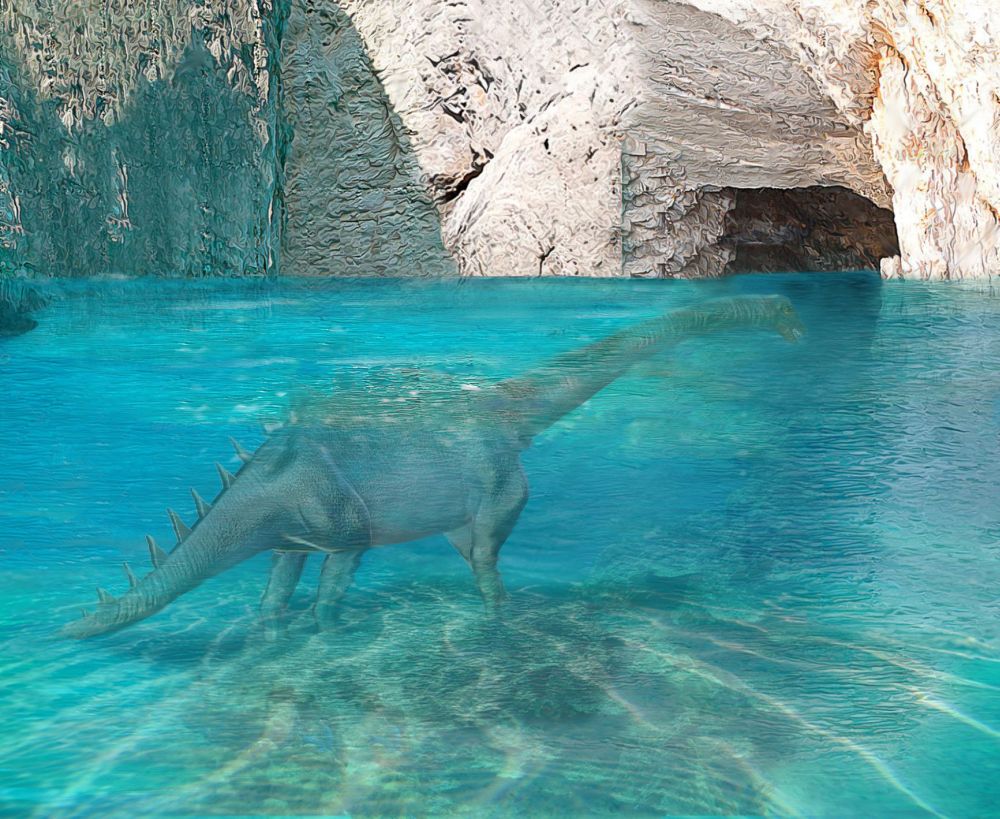
Alphones was facing south at the bottom of the reef stalking fish when, he says, he heard the sound of something crashing into the coral behind him. When Alphones turned around he was startled to see a large animal at close range, a distance of approximately five metres (c. 15 feet), fully submersed in the water. He says it moved slowly past from left to right and entered the left of two underwater caves located on the south side of Ambungi Island. (See Figure 3.)

Figure 3: An artist’s reconstruction of the animal seen entering an underwater cave on the south side of Ambungi Island.
Figure 3: An artist’s reconstruction of the animal seen entering an underwater cave on the south 
side of Ambungi Island.

Seeing the creature at such close range and being in the water with it, Alphones was terrified.

Alphones described the animal as having a long neck and tail and four legs, with the hind legs being longer than the front legs and the feet resembling those of a duck. The length of the animal was estimated to be four metres from the front legs to the end of the tail, with a height of two to three metres. The animal’s skin was stated to be dark brown, the texture of the skin could not be determined. The head of the creature was described as being small and similar to a snake’s head; no teeth were observed and the eye was described as being similar to the eyes of other animals. Dermal frills were observed on the animal’s back and tail, but not on the neck. The creature’s movement was described as being slow, with the tail moving noticeably. The neck of the creature was horizontal for the duration of the sighting, which lasted about 10 seconds. Seeing the creature at such close range and being in the water with it, Alphones was terrified. Wanting to escape with his life from this ordeal, Alphones promptly surfaced to reach his canoe and left the area quickly. He certainly didn’t hang around in hope of getting a glimpse of the creature’s body above the water!

Figure 4—At the foot of the cliff on the south side of Ambungi Island near the two underwater caves referred to in the main text.  Above: Russell 
Cook, donning the mask and snorkel, is preparing to take a quick look at the cave entrances, and the nearby coral.  Below: As Mr Cook enters the water, part of the entrance to the left cave 
(the one the creature was seen entering) can be seen at right. (These two photos guided the artist’s illustration of the background landscape of Figure 3.)
Figure 4—At the foot of the cliff on the south side of Ambungi Island near the two underwater 
caves referred to in the main text. Above: Russell Cook, donning the mask and snorkel, is preparing 
to take a quick look at the cave entrances, and the nearby coral. Below: As Mr Cook enters the water,
 part of the entrance to the left cave (the one the creature was seen entering) can be seen at right. 
 (These two photos guided the artist’s illustration of the background landscape of Figure 3.)

Figure 4b 
 
Figure 5: Alice Pasington (top left) tells of encountering a dinosaur in her garden.

The two underwater caves on the south side of Ambungi Island are separated by a distance of approximately 20 metres. The left cave has a circular entrance and has a height of about 2.5 metres. The right cave has a triangular entrance and also has a height of about 2.5 metres and appears from the outside to be considerably larger than the left cave. Neither cave has been explored because of the unavailability of sophisticated diving and lighting equipment.

A dinosaur in the garden?

In 1999 the second good sighting of one of these creatures occurred, however on this occasion the animal was observed on the land.

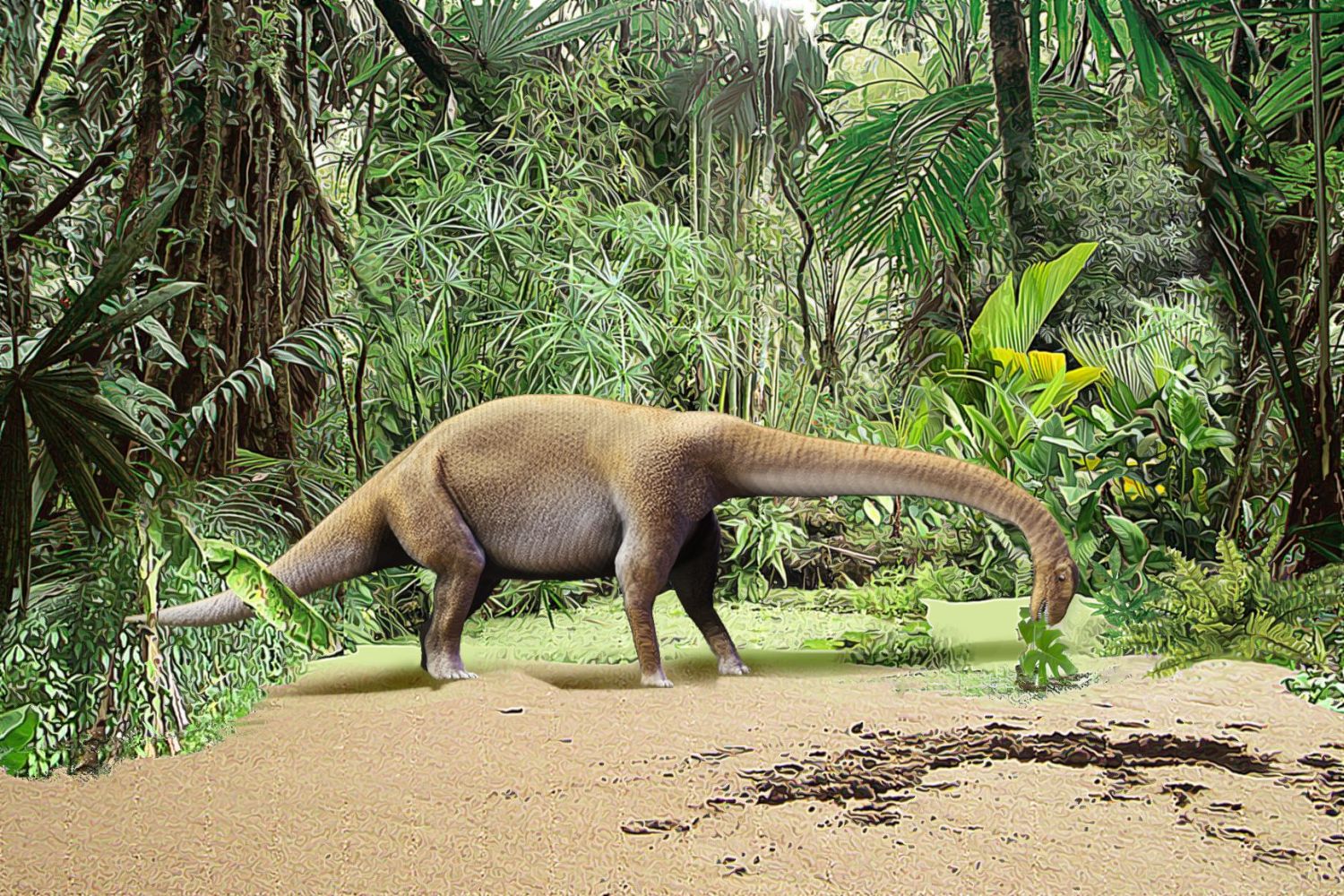
Alice Pasington (interviewed on 14th January 2012) was working alone in the garden on the south side of the island when she claims to have had an unusual encounter. From a distance of about 40 metres, Alice observed one of the creatures and estimated the total length to be about three metres. (See artist’s reconstruction in Figure 6.)

Figure 6: An artist’s reconstruction of the three-metre animal that Alice Pasington says she saw while working in the garden about 40 metres away.
Figure 6: An artist’s reconstruction of the three-metre animal that Alice Pasington says she saw 
while working in the garden about 40 metres away.

Figure 7:  The actual plant with the rough-textured leaf that Alice Pasington saw the animal eating.
Figure 7: The actual plant with the rough-textured leaf that Alice Pasington saw the animal eating.

The colour of the animal’s skin was reddish-brown and white around the breast area. The texture of the skin appeared smooth and dermal frills were seen only on the tail. The animal moved slowly with its neck nearly vertical and Alice saw it feeding on a plant with a rough-textured leaf (see Figure 7).
Alice then observed the animal turn around and walk to a small cliff, where it dived into the sea. During this time, the creature was followed at a distance and did not seem aware of Alice’s presence. After the animal had left the garden, Alice observed the five-toed footprints in the ground and later showed these footprints to other residents of Ambungi Island. The animal may have entered the garden from the beach on the western side of the island during the night. From the above description, it is possible that it may have been a juvenile specimen of the same type of creature as the other sightings, based on its size, colour, footprint and smooth skin texture.

Sleeping on a rock

Once the animal heard the sound of people, it moved from the rock back into the sea.

In 2007, Jasinta Pitim, another resident of Ambungi Island, observed the profile of a large animal sleeping on a rock on a reef on the south side of Ambungi Island. The animal was described as having a long neck that was curved back near its body, which was dark-brown, with skin described as being like a crocodile, and with dermal frills. Jasinta hurried home and told her husband Joe (interviewed on 14th January 2012), who travelled to the location, where he saw it too. Once the animal heard the sound of people, it moved from the rock back into the sea. Back in 1997 Joe and Jasinta observed a similar animal while travelling from Ambungi Island to Malengo Island in a canoe. From a distance of approximately eight metres the head and neck of the creature were visible for a short period of time.

Similar animals have also been observed on islands close to Ambungi Island.

Figure 8:  Joe and Jasinta Pitim observed a large aquatic animal sunning itself on a rock on a reef off Ambungi Island in 2007.  They had seen the head 
and neck of a similar creature protruding above the sea while travelling by canoe ten years earlier.
Figure 8: Joe and Jasinta Pitim observed a large aquatic animal sunning itself on a rock on a reef 
off Ambungi Island in 2007. They had seen the head and neck of a similar creature protruding 
above the sea while travelling by canoe ten years earlier.

2. Gasmata sighting

A creature similar to the one(s) observed around Ambungi Island has also been seen once near Gasmata. One afternoon in August 2004, three adults—Fabian Amon (see Figure 1), Simon Patolkit2 (Figure 9) and Margaret Patolkit—along with some children observed a sauropod-like creature on the south side of Dililo Island, an unpopulated island used mainly for farming by the local people from Gasmata.

Figure 9: The gentleman at the far left of this photo is Simon Patolkit, who along with his wife Margaret and others observed a huge creature in the sea 
off Gasmata. (See Figure 10.)
Figure 9: The gentleman at the far left of this photo is Simon Patolkit, who along with his wife 
Margaret and others observed a huge creature in the sea off Gasmata. (See Figure 10.) 

Simon was interviewed on 13th January 2012 at the location of the sighting and Fabian was interviewed on 18th January 2012. Both of their accounts of the sighting were very similar.
Simon, Margaret and Fabian were diving for fish on the reef on the south side of Dililo Island when they heard an unusual sound in the water and noticed that the fish were scattering. They became somewhat frightened by this incident and left the water for the safety of the land. A short time later, while sitting on some rocks, they observed part of an unknown animal above the water about 40–50 metres away and travelling in an east-west direction parallel to the coast.

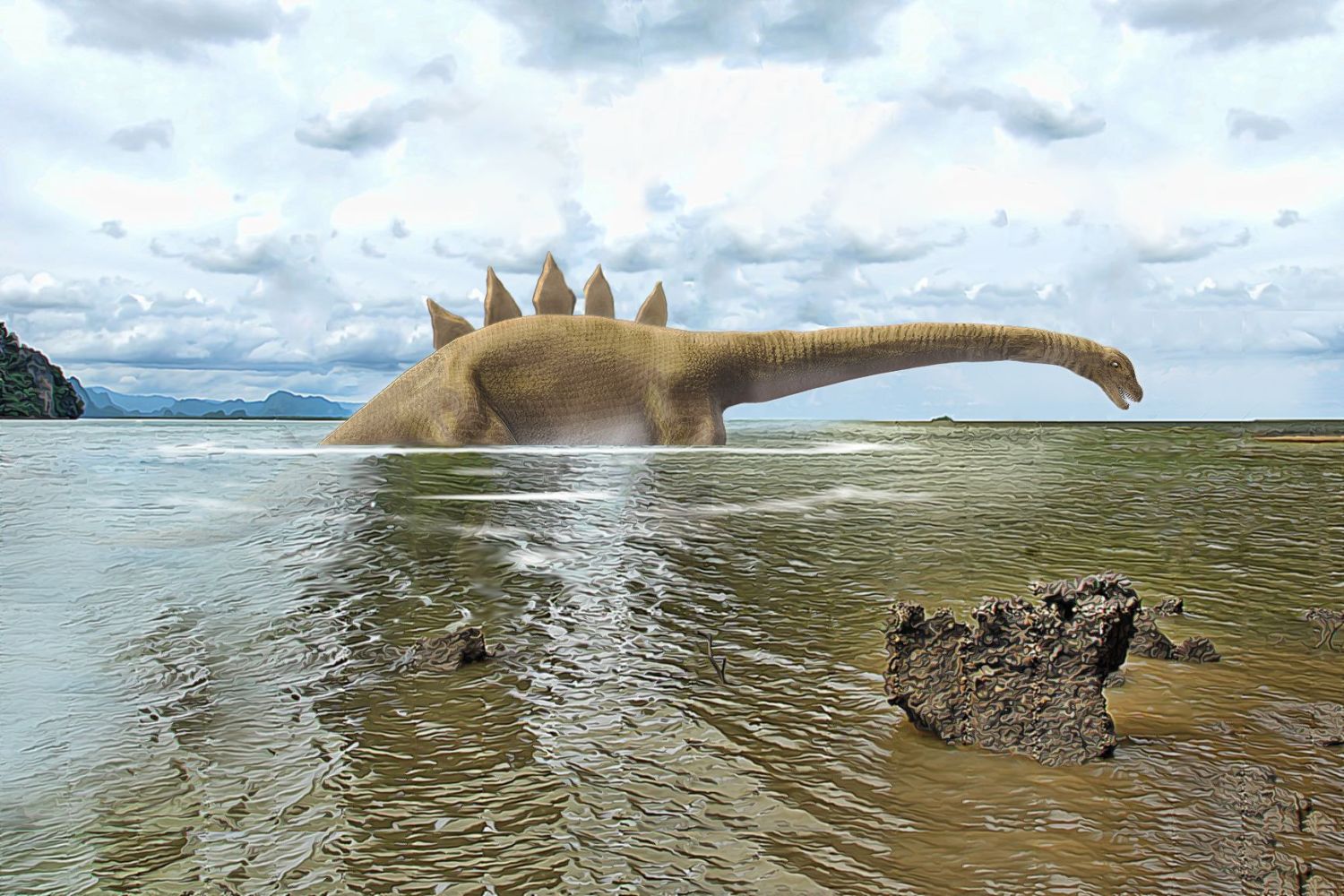
The creature had a large body and a neck estimated to be three metres long that was horizontal and close to the water. No tail or legs were visible and the total length of the visible portion of the animal was about eight metres. The head was like a crocodile or lizard and the eye was described as being ‘big’. The colour of the animal was uniform brown and the skin had a rough texture. The animal was described as having a ‘saw’ in the middle of its back, which consisted of 4 or 5 dermal frills. Observation time lasted about one minute during which time the creature moved slowly until it submersed itself fully in the water.

Figure 10: The creature observed at Gasmata Reef held its head and neck (about 3 metres long) just above the water and was described as having a 
‘saw’ in the middle of its back.  The visible part of the creature was estimated to be about 8 metres (26 feet) in length—but its total body length was likely 
considerably greater, given its tail was submerged and out of view.
Figure 10: An artist’s reconstruction of the creature observed at Gasmata Reef. It held its head and 
neck (about 3 metres long) just above the water and was described as having a ‘saw’ in the middle 
of its back. The visible part of the creature was estimated to be about 8 metres (26 feet) in length—
but its total body length was likely considerably greater, given its tail was submerged and out of view.

3. Possible theropod sighting in the north of West New Britain

A small theropod-like creature that local people have dubbed ‘Doren’ has been repeatedly observed around Benaule Village3, which is located approximately 25 km east of Kimbe on the north coast of West New Britain. The creature has been seen quite frequently for many years, with a close encounter reported in November 2010.

Figure 11: Pastor Ken-John showing the height of the ‘Doren’ he saw while using the toilet.
Pastor Ken-John was sitting on an ‘outhouse’ toilet at the Tabernacle Of Worship church during the day when he observed the profile of the head and upper torso of the ‘Doren’ appear only one metre away, just outside. The head was described as being like that of an aircraft (presumably like the profile of the nose of a jet, such as a 747) and the colour was medium brown. The animal has also been seen on the seashore near the church grounds by local people, where it comes ashore during high tide and travels back to the sea during low tide.

Figure 12: Pastor Ken-John stands by the sea in the grounds of the Tabernacle of Worship church, showing where he says the ‘Doren’ comes 
ashore at high tide.  With him are Ben (the landowner) and John.
Figure 12: Pastor Ken-John stands by the sea in the grounds of the Tabernacle of Worship church, showing where he says the ‘Doren’ comes ashore at high tide. With him are Ben (the landowner) and John.
The ‘Doren’ has been observed eating crabs and digging up vegetables from a garden.

A distinctive footprint of the ‘Doren’, which is described as being about 25cm long, is often seen in the sand by the sea. The left foot of the creature was drawn in the sand by a local person (see Figure 13). During the wet season, the ‘Doren’ travels inland along a creek to a mountain. The ‘Doren’ has been observed eating crabs and digging up vegetables from a garden near the church—apparently looking for worms and other invertebrates to eat, as it doesn’t normally eat the vegetables it unearths.

Figure 13:  The footprint of the ‘Doren’—as drawn in the sand by Ben (Figure 12).
Figure 13: The footprint of the ‘Doren’—as drawn in the sand by Ben (Figure 12). 


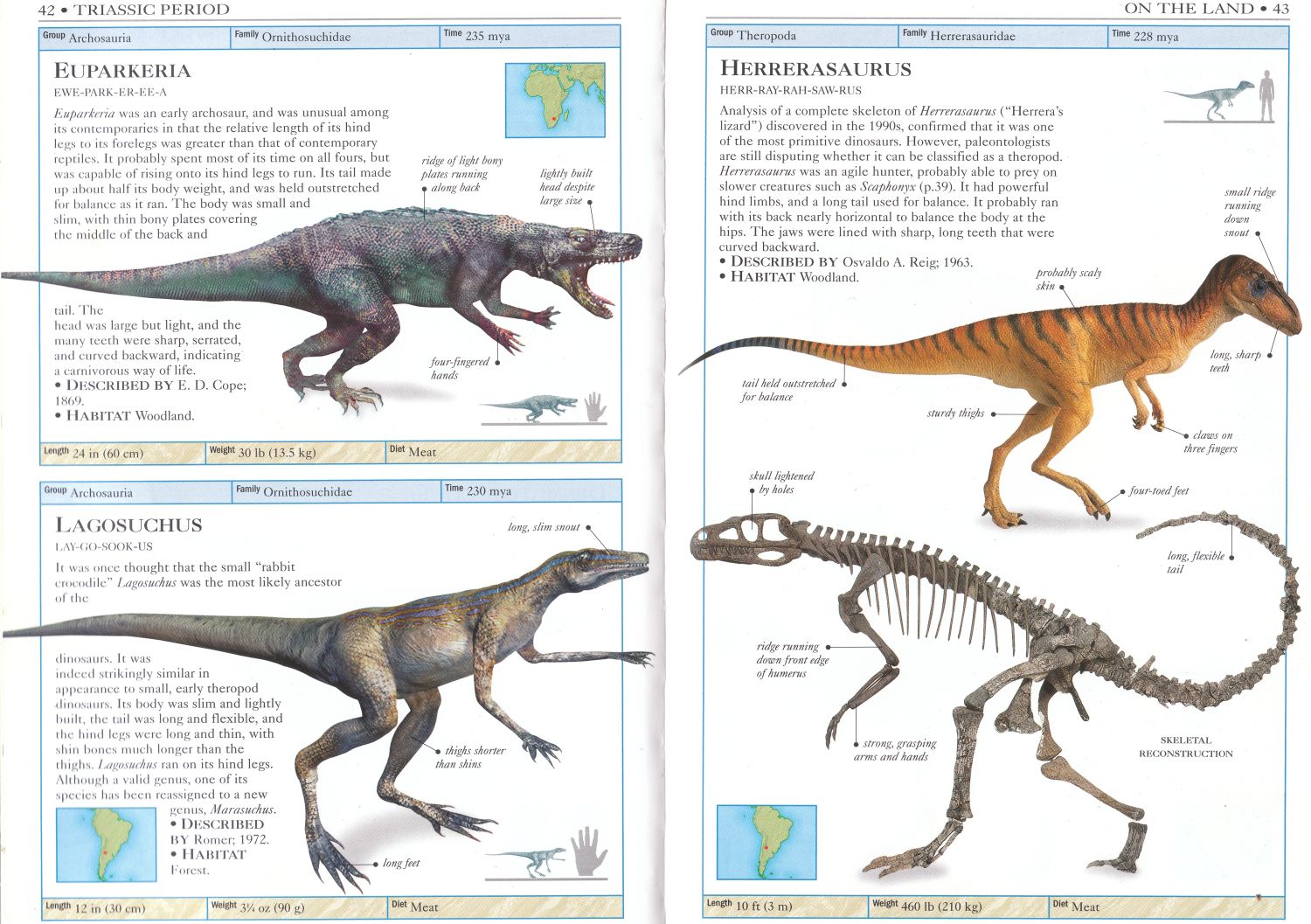
Figure 14: A scan of pages from the 2003 evolutionary dinosaur handbook by H. Richardson, Dinosaurs and prehistoric life, showing a scientific illustration of Herrerasaurus (on the right-hand page). Click for larger image. 

When walking, the ‘Doren’ uses four legs. However, when running the creature is reported as using rear legs only and as being able to outrun a human. It seems from the descriptions that the ‘Doren’ might be best identified as a Herrerasaurus.4

Concluding remarks

Reports alone are ultimately not enough to conclusively establish the fact that some dinosaurs are still alive today. However, if these are eventually backed up by hard evidence, the finding of living dinosaurs should not be such a surprise to people, considering that some animals and plants that were believed to be extinct for millions of years have been discovered alive. These discoveries include the Coelacanth fish (discovered in 1938) and the Wollemi Pine tree (discovered in 1994). For Christians it should be less surprising still, as the authority of the Bible is a solid basis for believing that humans have lived at the same time as dinosaurs (whether or not some dinosaurs still survive); because Genesis teaches that the heavens, the earth, and everything in them was created in that six-day period about 6000 years ago. The remains of dinosaurs (some of which are still ‘soft and squishy’, with identifiable proteins) would be no older than the Genesis Flood, which occurred about 4,500 years ago.

Thursday, August 9, 2012

What is the Truth about Dinosaurs? - Creation Today


What Is the Truth About Dinosaurs?

Eric Hovind and Paul Taylor answer the tough questions about dinosaurs. When were they created? Doesn’t carbon dating prove they are millions of years old? Did the devil put bones in the fossil record to mislead us? Why doesn’t the Bible mention the word dinosaur? Click here to download a FREE Bible study on dinosaurs in the Bible.


Tuesday, June 26, 2012

Dinosaurs Likely Still Alive in Africa Today


An excerpt from a program on The History Channel.

About mokele mbembe from http://www.mokelembembe.com/:


Mokele-mbembe
Artwork by Bill Rebsamen

Mokele-mbembe: The Living Dinosaur!

Introduction

In the jungles of central Africa countries of Congo, Cameroon, and Gabon are reports of animal an animal with a long neck, a long tail, and rounded shape tracks with three claws. The closest known animal that has these characteristics is a sauropod dinosaur.
When some of the local people of the Likouala region would draw in the dirt or sand a representation of Mokele-mbembe they drew the shape of a sauropod dinosaur. Then when they were shown a picture of a sauropod dinosaur they said that picture is Mokele-mbembe.
Mokele-mbembe means "One that stops the flow of rivers." French priest in the region called it "monstrous animal."
Mokele-mbembe is also used as a generic term to refer to other animals like Emela-ntoukaMbielu-mbielu-mbielu, and Nguma-monene.

Description

Body

Mokele-mbembe has been described as an animal with a long neck and tail which are characteristics of a sauropod dinosaur.
Its body size is somewhere between the size of a hippopotamus and an elephant. Its length has been reported to be between 5 to 10 meters (16 to 32 feet). The length of the neck is between 1.6 to 3.3 meters (5 to 10 feet). The length of the tail is between 1.6 to 3.3 meters (5 to 10 feet). The reports out of Cameroon have reported Mokele-mbembe to be up to 75 feet in length.
There have also been reports of a frill on the back of the head. The frill is like the comb found on a cock (male chicken). There has also been reports of it having a horn on its head.

Skin

The color of the skin is predominately reddish-brown with a color range from gray to brown. There are no reports of hair on the animal.

Tracks

Rounded shape between 30 to 90 centimeters (1 to 3 feet) in diameter with three claws. The distance between tracks is about 2.1 to 2.4 meters (7 to 8 feet).

Sound

The basic belief is that Mokele-mbembe does not make any sounds, though there have been come conflicting reports. This is probably due to the fact that Mokele-mbembe is used generically for other animals and the sound is being confused with Emela-ntouka which makes a sound like a snort, howl, roar, rumble, or growl.

Habitat

Mokele-mbembe lives in the pools and swamps adjacent to the rivers of the Likouala swamp region of The People's Republic of the Congo on the continent of Africa. Its uses the lakes as a crossing path to go from one river to another river.

Diet

The pygmies of the Likouala swamp region report that the essential diet of Mokele-mbembe consists of the Malombo plant. Since it only eats plants then Mokele-mbembe is classified as a herbivore. The Malombo plant actually describes two plants: Landolphia mannii and Landolphia owariensis.

Behavior

Mokele-mbembe lives most of the time underwater except when it eats or travels to another part of the swamp.
It has as been reported that Mokele-mbembe does not like hippopotamuses and will kill them on sight, but it does not eat them. Hippopotamuses cannot be found where Mokele-mbembe lives.
It has as been reported that Mokele-mbembe will overturn boats and kill the people from the boats by biting them and hitting them with its tail, but it does not eat the people.

Sightings

  • April 2000 - Cameroon, Boumba River, Two Congolese security guards

Expeditions

  • 2001 - February/March - CryptoSafari, Cameroon
  • 2000 - November - Gibbons-Wetzel, Cameroon
  • 1992 - Operation Congo 2
  • 1992 - Japanese Expedition

Bibliographies

  • A Living Dinosaur? In Search of Mokele-mbembe by Dr. Roy P. Mackal
  • Drums Along the Congo: On the Trial of Mokele-mbembe, the Last Living Dinosaur by Rory Nugent.
  • Results of the First Congolese Mokele-Mbembe Expedition by Agnagna, Marcellin
  • On the Track of Unknown Animals by Dr.Bernard Heuvelmans
  • Les Derniers Dragons d'Afrique (The Last Dragons of Africa) by Dr.Bernard Heuvelmans
  • In Search of Prehistoric Survivors: Do Giant 'Extinct' Creatures Still Exist by Dr. Karl Shuker

Links


Wednesday, March 21, 2012

Dinosaurs, They Don't Come With Directions - Tommy Lohman

Part 1

presented at Rocky Mountain Creation Fellowship Nov 11, 2011 by Tommy Lohman of Creation
Connection Ministries

Part 2


From a very early age, Tommy's fascination with dinosaurs was strong, but the unseen indoctrination attached to dinosaurs distorted his understanding of the early chapters of Genesis. Constant "old earth evolution" and silence from the church continued to cloud his understanding and caused him to doubt Genesis as a literal account of the early history of the world.

 Being raised in church did not insulate him from these anti-God, anti-gospel influences. In 1993, he recon-nected with his childhood fascination with dinosaurs. After watching Steven Spielburg's movie "Jurassic Park," he began to sense that previously held beliefs about Genesis, dinosaurs and the age of the earth were not properly rooted. God then led him to a diligent study of the Bible, starting with Genesis 1-11.

Dr. Henry Morris' book, "The Beginning of the World," and the creationist ministry "Answers in Genesis" revealed truths about the beginning of the world and dinosaurs Tommy had never considered before. The past 18 years of his life have been dedicated to the study of creation by starting with a literal approach to history in Genesis.

Creation Connection Ministries was founded on a simple desire to "connect the dots" about the truth of the beginning of the world by using the Bible, beginning with Genesis, as a foundation for a sound, Biblical worldview. In 2008, God stirred his soul and showed him that creation apologetics simply for information's sake was insufficient; there was a deeper need for sound creation teaching in the defense of the gospel of our Lord Jesus Christ. As a result, it is his heart's desire to bring all presentations, conversations and writings about creation apologetics back to the heart of the matter: the foot of the cross.