ORIGINS | A variety of evidences for the receding of the Floodwater off the continents will be provided. Geological evidence is first presented for differential vertical tectonics to drain the Floodwater. As the Floodwater first drains as wide currents, great erosion occurs with the formation of planation surfaces and the long transport of resistant rocks. As more and more land is exposed above the Floodwater, the water becomes more channelized forming another set of unique landforms. Water and wind gaps, pediments, and submarine canyons will be described. All these features are very difficult, if not impossible, to explain by the uniformitarian paradigm, providing strong evidence for the reality of the Genesis Flood.
Michael Oard
Michael has a Masters Science degree in Atmospheric Science from the University of Washington and is now retired after working as a meteorologist with the US National Weather Service for 30 years. He has researched and speaks on the compelling evidence for Noah’s Flood and the Ice Age that followed, and how the incredible wooly mammoth connects to biblical history. Michael has published many papers in his field in widely recognised journals and has written An Ice Age Caused by the Genesis Flood, Ancient Ice Ages or Gigantic Submarine Landslides?, The Missoula Flood Controversy and the Genesis Flood and The Frozen Record. He is also author of Frozen in Time, The Weather Book and Life in the Great Ice Age.
He serves on the board of the Creation Research Society, USA and lives in Montana.
Carl has been active in creation geology since 1988. He has a Bachelor of Science in geology from the University of South Alabama and his geological career has encompassed a wide range of activities. These include oil and gas exploration, public health related soil analysis, groundwater aquifer containment, underground waste management, and groundwater modelling. At present he is employed as a professional geologist with the US Government Environmental Protection Agency dealing with geological aspects of waste disposal.
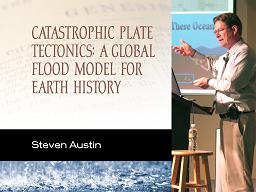
How did the catastrophic sedimentary and tectonic processes associated with the global flood form the world we see? Catastrophic plate tectonics was the theory devised by creationists 150 years ago to explain the geology of continents and ocean basins. Lately, creationists have modeled the ocean-floor upheaval that initiated the flood, subducted the pre-flood ocean floor, and propelled the oceans over the continents. Subduction of the pre-flood ocean floor moved continents into their present positions, and enlarged and deepened ocean basins. Major mountain ranges are the product of plate collisions. Left over heat and global cooling following the flood created the rapid post-flood ice age and Earth’s modern climate.
Dr. Steven A. Austin is a field research geologist with a Ph.D. from Penn State University in sedimentary geology. He is “Senior Research Scientist” with Institute for Creation Research in Dallas, Texas. He has performed geologic research on six of the seven continents of the world. His research adventures have taken him by helicopter into the crater of Mount St. Helens volcano, by bush plane onto glaciers in the high mountains of Alaska, by raft through the entire Grand Canyon, on horseback into the high Sierra, by elevator into the world’s deepest coal mines, by SCUBA onto the Great Barrier Reef of Australia, by rail into the backcountry of Korea, by foot onto barren plateaus of southern Argentina, and by four-wheel drive into remote desert areas of Israel, Jordan and Saudi Arabia. He is the author of three books, three videos, one computer software package, and more than thirty technical geology papers.
Dr. Austin’s field research within Grand Canyon includes over 400 nights camped out below the Canyon’s rim. He has launched 22 raft trips within Grand Canyon. He has explored very remote areas of Grand Canyon by mule, helicopter and ATV. His book “Grand Canyon: Monument to Catastrophe” and his DVD “Grand Canyon: Monument to the Flood” summarize his investigations. He has over ten technical papers on Grand Canyon. Subjects of his technical publications on Grand Canyon include lava dams, breached dams, fossils, limestones, sandstones, basalts, diabase sills and radioisotope dating. He is widely known for his discovery of the regionally extensive mass-kill and burial bed within the Redwall Limestone about 2000 feet below the Canyon’s rim.
Download Windows Media Video file: right-click link below and choose "Save Target As"
The biblical Flood and geology—a closer look at plate tectonics
and how they could explain the biblical Flood. An approach from world's
mythology is also taken, proving the global character of the Flood.
Evidence from the geologic and fossil records is analyzed and explained
in accordance with the biblical account.
Dr Silvestru earned his Ph.D in geology at the ‘Babes-Bolyai’ University
in Cluj, Romania (where he has worked as an associate professor), in karst sedimentology
including caves. (Karst is a term which initially referred to barren regions of
mostly limestone and dolomite, noted for spectacular and distinctive landforms,
and with substantial underground drainage features — caves, underground rivers,
etc. It has come to refer more to the entire geosystem, above and below ground.)
A world authority on the geology of caves, he has published 41 scientific papers
(see below), written one book (The Cave Book—see
below) and co-authored two books. He was, until recently, the
head scientist at the world’s first Speleological Institute (speleology =
the study of caves) in Cluj. Since 1997 he has been a full-time researcher and speaker
with CMI.
His areas of expertise include: Sedimentology of clastic deposits, stratigraphy
of limestone terranes, general geology, karst genesis and functioning, cave climate
and glaciology, show-cave assessment & designing, ore prospecting and exploration
(surface and mining).
After becoming a Christian he quickly realized that the ‘millions of years’
interpretation, so common in geology, was not compatible with Genesis. ‘Once
I became a Christian,’ Emil says, ‘I knew I had to “tune up”
my scientific knowledge with the Scriptures.’
‘Although philosophically and ethically I accepted a literal Genesis from
my conversion, at first I was unable to match it with my “technical”
side.’
E-mail discussions with qualified creationist geologists, creationist books, Creation magazine and especially the Journal
of Creation (formerly TJ) helped him realise what he calls
two ‘essential things’:
Given exceptional conditions (e.g. the Genesis Flood) geological processes that
take an extremely long time today can be unimaginably accelerated.
The Genesis Flood was global, not regional.
‘These factors were immensely important in my conversion and my Christian
life. I am now convinced of six-day, literal, recent, Genesis creation. That doesn't
mean that there are not still some unanswered problems, but researching such issues
is what being a scientist is all about.’
He has over 30 years experience in climbing and spelunking, educating many young
spelunkers and mountain climbing devotees as well as participating in mountain and
cave rescue operations.
In January 2002 he immigrated to Canada from Romania with his wife and two daughters.
In addition to doing research and writing for CMI, he now also on staff at CMI Canada
as a Seminar Lecturer, and has written a number of articles for the Journal of Creation, Creation magazine
and this website, and produced several DVDs.
In 2012 Emil suffered a stroke from which
he has not yet fully recovered.
Dr Silvestru’s papers published in secular science journals
Viehmann Iosif, SILVESTRU Emil, Fabian Calin (1979) La Grotte d'Iza, Monts de Rodna,
Roumanie. Travaux de l'Institut de Spéologie “Emil Racovitza”,
Bucureşti, t.XVIII:201–207.
SILVESTRU Emil, Viehmann Iosif (1982) Etude de microtectonique comparée dans
le karst des Monts de Rodna (Roumanie). Travaux de l'Institut de Spéologie
“Emil Racovitza”, Bucureşti, t.XXI:63–67.
SILVESTRU Emil (1984) The Relationship Between Tectonics and Karstification in the
Cave from Izvorul Tausoarelor (Rodna Mountains). Theoretical and Applied Karstology,
Bucureşti, 1:35–42.
Soritau Dan, Nicoara Dorel, SILVESTRU Emil, Demeter Janos, Popa Cristian, Viehmann
Iosif (1984) Avenul din Stanul Foncii. Bull."Pestera", Cluj–Napoca,
1:79–88.
SILVESTRU Emil (1985) Aspects of Karstification in the Crystalline Limestones on
the Southern Slope of Rodnei Mountains. Theoretical and Applied Karstology,
Bucureşti, 2:87–95.
SILVESTRU Emil (1988) New Ideas on the Cretaceous/Tertiary Extinctions. Evolution
and Adaptation, Cluj–Napoca, III:89–97.
Mârza Ioan, SILVESTRU Emil (1988)First Mention of the Hydrothermal Karst Phenomenon
Associated to Neogene Metasomatic Suplhide Ore deposits from Rodna Veche. Studia
Universitatis “Babes-Bolyai”, Geologica-Geographica, Cluj-Napoca,
XXXIII:77–81.
Cocean Pompei, SILVESTRU Emil (1988)The Role of Magmatism in the Genesis of Isolated
Massifs Karst Relief of the Trascau–Metaliferi Mountains. Travaux de l'Institut
de Spéologie “Emil Racovitza”, Bucureşti, t.XXVII:89–93.
SILVESTRU Emil (1989) Several Considerations on the Tectonics of the Underground
Fossil Glacier in the Cave Ghetarul de la Scarisoara (Romania). Travaux de l'Institut
de Spéologie “Emil Racovitza”, Bucureşti, t.XXVIII:77–86.
Cociuba Ioan, SILVESTRU Emil (1989) Hypothesis on a genetical Relation Between the
Actual Karst and the Bauxite-Bearing paleokarst at the Jurassic/Creatceous Boundary
in the Piatra Craiului Mountains (Romania). Travaux de l'Institut de Spéologie
“Emil Racovitza”, Bucureşti,t.XXVIII, p.87–90.
SILVESTRU Emil (1990)Propositions pour une classification litho–génétiquedes
formes karstiques et apparentées. Karstologia, La Rivoire, France.
Nr.15:55–57.
SILVESTRU Emil (1990) On the Genesis and Evolution of Mirabilite in the Cave Izvorul
Tausoarelor (Romania). Travaux de l'Institut de Spéologie “Emil Racovitza”,
Bucureşti, t.XXIX:79–84.
Racovita Gheorghe, Boghean Viorel, SILVESTRU Emil, Petrescu Mircea (1991) Etude
thermométrique des substratums de la grotte de Scarisoara. Travaux de l'Institut
de Spéologie “Emil Racovitza”, Bucureşti, t.XXX:159–184.
SILVESTRU Emil, Boghean Viorel (1992) Ultrasonic Investigations on the Underground
Fossil Glacier in the Cave Ghetarul de la Scarisoara (Romania). Travaux de l'Institut
de Spéologie “Emil Racovitza”, Bucureşti, t.XXXI:151–154.
SILVESTRU Emil (1993) Karst and Global Climate (a Gaian Approach). Proceedings
of the European Conference on Speleology, Helecine, Belgium, 2:125–127.
SILVESTRU, Emil (1993) Apusul gigantilor — o poveste cu dinozauri. In Petrescu
Iustinian (coordinator) Terra — catastrofe naturale. Editura Dacia
Cluj-Napoca, 259p.
SILVESTRU Emil (1994) Karst and Environment — a Romanian Approach. Geological
and Landscape Conservation (O'Halloran, D., Greene, C., Harley, M., Knill,
J., editors) London, Geological Society, p.221–225.
SILVESTRU Emil, Ghergari Lucretia (1994) On the Paleokarst in the Cave Ghetarul
de la Scarisoara (Bihor Mountains, Romania). Theoretical and Applied Karstology,
Bucureşti, 7:155–161.
SILVESTRU Emil (1995)Can One Define Poljes? Acta Carsologica, Ljubljana,
Slovenia, XXIV:501–508.
SILVESTRU Emil, Tamas Tudor, Fratila Gheorghe (1995) Preliminary Data on the Hydrogeology
of Karst Terrains Around the Springs of Somesul Cald River (Bihor-Vladeasa Mountains,
Romania). Theoretical and Applied Karstology, Bucureşti, 8:81–89.
Pourchet Michel, Mélieres Marie Antoinette, SILVESTRU Emil, Rajka Géza,
Candaudap Froncois, Carbonnel Jean-Pièrre (1996) Radionuclides in a Cave
Lake Sediment Core from Ghetarul de Sub Zgurasti (Romania). Theoretical and Applied
Karstology, Bucureşti, 9:23–28.
SILVESTRU Emil, Mátyási Sándor and Bucur I. Ioan (1996) Proposal
for a series of formal lithostratigraphic units from the Lower Triassic to the Upper
Jurassic in the Central Bihor Mountains (Apuseni Mountains, Romania). Studia Universitatis
“Babes-Bolyai”, Geologia, XLI(2):131–136,
Cluj.
SILVESTRU Emil (1997) Stratigrafia si sedimentologia depozitelor clastice din exo–
si endocarstul zonei Padis-Cetatile Ponorului. Teza de doctorat (PhD thesis)
Universitatea “Babes-Bolyai” Cluj-Napoca, 240 pp.
SILVESTRU Emil (1997) Dolines in the Padis Plateau (Bihor Mountains, Romania) —
One Peculiar Case, Many Questions. Theoretical and Applied Karstology, Bucureşti,
10:127–132.
SILVESTRU Emil (1998) Lithostratigraphic control of karstification: a Romanian example.
Études de Géographie Physique, Supplément au nº XXVII:31–34,
Arras, France.
SILVESTRU, Emil (1999) Perennial ice in caves in temperate climate and its significance.
Theoretical and Applied Karstology, Bucureşti, 11–12:83–94.
Canada’s Dr Emil Silvestru
has unfortunately suffered a stroke. Although he is recovering remarkably well given
the severity of the stroke, please pray for Emil’s full recovery and for CMI-Canada
while Emil is unable to do any speaking.
Emil has fully recovered his musculo-skeletal functioning (the physiotherapy being
performed by his wife Flory) but recovery of speech function is proceeding slowly.
Emil is currently receiving Employment Insurance but this only amounts to a little
more than half of his regular modest salary. With the family having arrived from
communist Romania penniless late in life, this leaves them in significant difficulty,
and the ministry’s capacity to help is limited.
If you feel led to help the Silvestrus financially please send a cheque to them
directly at: 45311 Spruce Dr Chilliwack, BC V2R 1E9
Please be aware of potentially high banking fees if sending cheques drawn on foreign banks.

 Michael has a Masters Science degree in Atmospheric Science from the University of Washington and is now retired after working as a meteorologist with the US National Weather Service for 30 years. He has researched and speaks on the compelling evidence for Noah’s Flood and the Ice Age that followed, and how the incredible wooly mammoth connects to biblical history. Michael has published many papers in his field in widely recognised journals and has written An Ice Age Caused by the Genesis Flood, Ancient Ice Ages or Gigantic Submarine Landslides?, The Missoula Flood Controversy and the Genesis Flood and The Frozen Record. He is also author of Frozen in Time, The Weather Book and Life in the Great Ice Age.